New in :Recruit – Revamped Talent Landing Pages
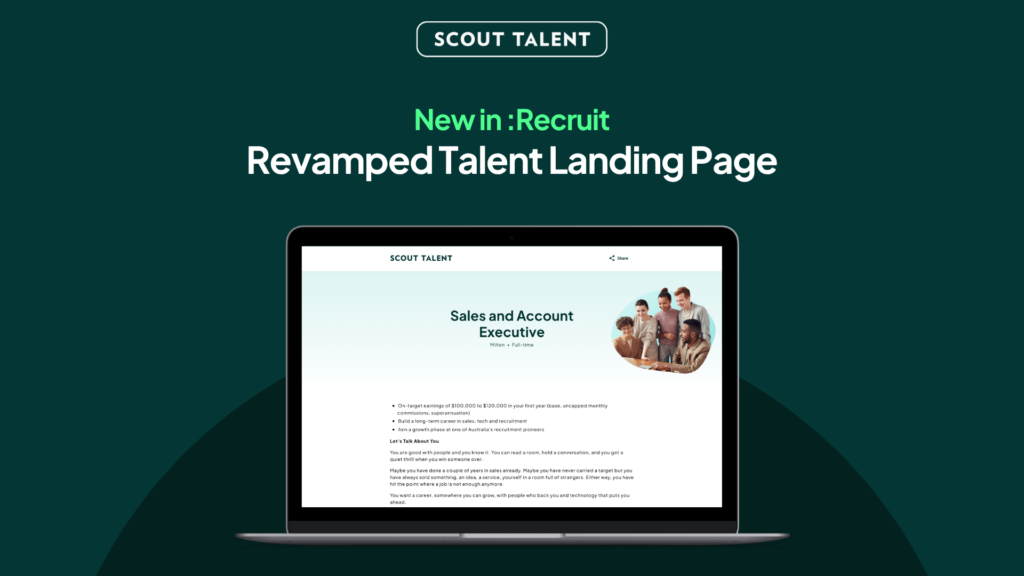
A better first impression for every role Your job landing page is often the first real impression a candidate has of your organisation. But older landing pages can look dated, feel inconsistent from one device to the next, and create barriers for candidates who rely on assistive technology, which means strong candidates may lose interest before they ever reach your application form. Today, we’re launching the new Talent Landing Page (TLP), a refreshed, accessible, brand-led design that helps your roles make a stronger first impression and gives every candidate a smoother path to apply. What’s New in a Nutshell Your employer brand, front and centre: A modern layout and design reflects your organisation, its values and its brand. Accessible by design: Built to WCAG accessibility standards, so more candidates, including those using assistive technology, can read your ad and apply with confidence Faster and consistent everywhere: A quicker, cleaner page that looks and works the same across desktop, tablet, and mobile A smarter, faster apply experience: Candidates can auto-complete their details from an uploaded resume, easy-complete from Seek and Indeed, and use Smart Response for helpful feedback on their screening answers before they submit Why We Built the New TLP Attracting the right candidates starts well before the application form. The look, clarity, and accessibility of your job landing page all shape whether a candidate decides your role is worth their time. That is why Scout Talent has continued to invest in the candidate-facing experience, not just the tools your team uses behind the scenes. The new TLP builds on that direction. Rather than presenting your roles on a dated, one-size-fits-all page, the new design puts your employer brand first, meets modern accessibility expectations, and loads faster and more consistently across devices. It is not a change to your screening questions or application process. It is a better home for the roles you are already advertising, designed to help you attract and convert more of the right candidates. What This Means For Your Team The new TLP delivers three key improvements to your candidate attraction: A stronger employer brand: Your header image, About Us content, and optional video help each role feel like your organisation, not a generic template. A more branded, professional page helps you stand out and build trust with candidates early. A more inclusive application experience: The page is built to WCAG accessibility standards, with features such as keyboard navigation, skip links, and a clear heading structure. This widens the pool of candidates who can comfortably engage with your roles and helps you meet growing accessibility expectations. A map is also included to ensure candidates can quickly narrow down a job’s location. A smoother, smarter path to apply: On a faster, mobile-friendly page, candidates can auto-complete their details from an uploaded resume, easy-complete from Seek and Indeed, and get AI feedback on their screening answers with Smart Response. This reduces drop-off and lifts the quality of the responses your team receives. How to Get Started The new TLP is set up for your organisation by our team, so your branding is applied correctly before it goes live. Getting started is simple: 1 Explore the new design so you can see how your roles could look 2 Gather your branding: your header image, brand colours, About Us content, and an optional About Us video or Image 3 Share your design preferences with your Customer Success contact 4 Confirm your design, then we set it up for your organisation 5 Your new Talent Landing Page goes live across your job advertisements Frequently Asked Questions (FAQ) Do I need to do anything to switch to the new design? Yes. The new TLP is set up per organisation so your branding is applied correctly before it goes live. It is not a switch you turn on yourself. Contact your Customer Success team to get started and they will guide you through it. Will this change my screening questions or application process? No. Your jobs, screening questions, and workflows stay exactly as they are. The new TLP changes how your role is presented to candidates, not how you screen or manage applications. Is the new design accessible? Yes. The new TLP is built to WCAG accessibility standards, with features such as keyboard navigation, skip links, and a clear heading structure. This helps more candidates, including those using assistive technology, read your advertisement and apply. Does it work on mobile? Yes. The page is responsive and designed to look and work consistently across desktop, tablet, and mobile, so candidates get the same quality experience wherever they apply. Can I include a video? Yes. The About Us section supports an optional YouTube or Vimeo video alongside your written content. A video is not required, so you can choose whether to include one or replace it with an image Does the new TLP include Smart Response and quick-apply features? Yes. The new TLP brings the smarter apply experience together in one place. Candidates can auto-complete their details from an uploaded resume, easy-complete from Seek and Indeed, and use Smart Response to get AI feedback on their screening answers before submitting. The result is a faster application for candidates and clearer, more complete information for your team. Will my existing job links still work? Yes. Your job advertisement links continue to work. Once the new TLP is set up for your organisation, those same links present your roles using the new design. Ready to give your roles a stronger first impression? The new Talent Landing Page helps you attract more of the right candidates with a modern, accessible, brand-led design, while keeping the jobs, questions, and workflows your team already relies on. Make a better first impression on every role with the new Talent Landing Page. For more details on setup and best practices, contact our Customer Success team
How to Get More Qualified Job Applicants: A Troubleshooting Guide for In-House Recruiters

The role has been live for two weeks. The pipeline is underwhelming. Either there are too few applicants, the quality is off, or both. At this point, most teams reach for the same solution. Increase exposure. Boost the ad. Spend more. That’s usually not where the problem starts. When an organisation isn’t getting enough qualified applicants, the first step is to understand what’s actually happening inside the process. “Not enough qualified applicants” isn’t a diagnosis. It’s a symptom. Before making any changes, it’s critical to determine whether this is a visibility problem, a conversion problem, or a fit problem. Each requires a completely different fix. This isn’t about adding more tactics. It’s about troubleshooting the hiring funnel. Key Takeaways Most low applicant problems are funnel issues, not volume issues Increasing ad spend without fixing underlying issues amplifies the problem Identifying where candidates drop off is critical before making changes Small adjustments like salary transparency or simplifying applications can significantly improve results Conversion data provides the fastest path to diagnosing and fixing hiring challenges Why “Just Boost the Ad” Is Rarely the Right Answer When a job ad underperforms, the instinctive response is to spend more. Upgrade the listing. Sponsor the post. Add more job boards. Run paid campaigns. In most cases, this is the wrong move. More spend on a broken ad simply accelerates poor results. If the ad is unclear, the salary is missing, or the application process is too long, additional traffic won’t fix the issue. It will amplify it. Before increasing spend, organisations need to understand what’s happening inside the funnel. At a minimum, that means tracking how many people saw the ad, how many clicked, how many started applying, and how many completed the process. Start Here: Diagnose Where the Problem Is in Your Hiring Funnel Most organisations approach hiring as a marketing challenge. The assumption is that more applicants are needed. A more effective approach is to treat recruitment as a funnel and focus on what happens to candidates once they enter the process. The funnel can include impressions, views, application starts, application completions, screened candidates, interviews, offers, and hires. Each stage has its own conversion rate. This approach forces specificity. Instead of saying “the ad isn’t working,” teams can identify exactly where the breakdown occurs, such as a low application start rate despite high views. Once the issue is clear, the fix becomes targeted, fast, and often inexpensive. Is Your Job Ad Being Found? If a job ad isn’t generating views, the issue is visibility. Common causes include job titles that don’t match candidate search behaviour, posting on the wrong platforms, poor keyword optimisation, or being buried under high volumes of competing listings. A frequent issue is the use of internal job titles that candidates would never search for. For example, “Customer Success Architect” instead of “Account Manager.” A simple test is to search for the role the way a candidate would. If the ad isn’t appearing within the first few pages of results, visibility is likely the problem. No candidate applies to a role they have never seen. Is Your Job Ad Being Read but Not Applied To? If the ad is receiving views but not applications, the issue lies within the content. Candidates are finding the ad and clicking through, but something is causing them to disengage. In most cases, this comes down to four factors: The role does not sound compelling The requirements are unrealistic The salary is missing or unclear The application process appears too demanding A common mistake is leading with company information instead of the role itself. Candidates decide within seconds whether to continue reading, and generic company history rarely holds their attention. In one case, a manufacturing company had a role with around 1,800 views and only 11 applicants. The ad had no salary, opened with company history, and listed 14 requirements. After rewriting the opening to focus on the role, adding a salary range, and reducing the requirements to six essentials, applications increased significantly within two weeks, along with a noticeable improvement in quality. Start using job description templates to quickly improve your ad’s effectiveness. Are Candidates Starting the Application but Not Completing It? The candidate has already shown intent by clicking apply, but the process itself causes them to abandon it. The most common causes are friction-related: Long or complex application forms Requiring candidates to re-enter information already on their resume Mandatory account creation Early-stage “homework” questions Poor mobile usability With more than half of candidates applying via mobile, a non-optimised process leads to significant loss. The fix is simple. Strip the application down to essentials: name, contact details, resume, and one or two critical screening questions. One Scout Talent client simplified their application form and increased completion rates from 34 percent to 81 percent. With the same ad and no additional spend, applicant volume nearly tripled. This is often where a well-configured applicant tracking system makes the biggest difference, helping remove unnecessary steps and reduce friction in the application experience. Are Applicants Applying but Not Meeting Your Criteria? If application volume is strong but quality is low, the issue is targeting. This typically stems from vague role descriptions or poorly defined requirements. Many job ads are written from an internal perspective, focusing on titles and reporting lines rather than what the candidate will actually do. When descriptions lack clarity, they attract a broad and often unsuitable applicant pool. When they are specific about responsibilities and outcomes, they naturally filter for stronger candidates. How To Use The STAR Method To Assess Selection Criteria Responses When a job ad isn’t converting, four changes consistently make the biggest impact: Rewrite the opening to focus on the candidate Include a clear salary range Reduce requirements to essential criteria Simplify the application process These changes are quick to implement and often produce immediate results. For time-constrained teams, focusing on salary transparency and the opening paragraph delivers the fastest improvement. Write for Your Candidate, Not Your Hiring Manager A
Diversity, Equity & Inclusion: AI-Driven Strategies to Enhance DEI

Creating and maintaining a diverse and inclusive workforce continues to be a priority for organisations and a top business imperative. Companies recognise that fostering diversity, equity, and inclusion (DEI) can lead to more innovative solutions, better decision-making, and a stronger connection with a diverse customer base. According to LinkedIn, 76% of employees and job seekers said diversity was important when considering job offers. Companies with diverse workforces are 35% more likely to outperform their peers, highlighting the tangible benefits of a strong DEI strategy. Furthermore, 84% of HR professionals state that DEI is critical to the future success of their organisation, underscoring the strategic importance of these initiatives. Achieving DEI goals in recruitment, however, still has its challenges. Unconscious bias remains a significant barrier, as recruiters may unknowingly favour candidates who resemble themselves or fit certain stereotypes. Traditional recruitment methods often rely on existing networks, limiting the diversity of your talent pool. Introducing AI as a new tool to support Talent Acquisition and Recruitment Professionals presents an exciting opportunity. AI has the potential to significantly enhance recruitment processes by addressing unconscious biases and broadening the diversity of candidate pools. AI tools can analyse vast amounts of data to identify and flag biased language in job descriptions, recommend more inclusive alternatives, and source candidates from a wider range of backgrounds. Additionally, AI can automate resume screening and standardise interviews, ensuring a more objective and equitable evaluation process. Benefits of DEI Initiatives Diversity, Equity, and Inclusion are pillars of modern recruitment strategies. Diversity refers to the range of different characteristics and experiences within a workforce, including race, gender, age, and more. Equity ensures that all employees have fair access to opportunities and resources tailored to their unique needs, fostering a level playing field. Inclusion is about creating an environment where all individuals feel valued and empowered to contribute fully. All in all, a diverse workforce drives innovation by bringing varied perspectives to the table, enhancing problem-solving and decision-making, and ultimately leading to better business outcomes. Key Advantages of Implementing DEI Initiatives: Attracts a Wider Pool of Top Talent: Companies with strong DEI practices tend to have better reputations and are more attractive to top talent. Improves Employee Engagement and Retention: Inclusive workplaces are known to have higher employee engagement and retention rates, as employees feel valued and respected. Increases Revenue: Companies with diverse teams are more likely to achieve better financial results. Organisations that embrace DEI see increased revenue and profitability, as diverse perspectives lead to more effective decision-making and innovative solutions. Increases Innovation and Growth: Diversity boosts innovation by bringing a wide range of perspectives, leading to creative problem-solving and growth. Forbes highlights that diverse teams are better at developing new ideas and products, driving business growth. (Source: Forbes) 5 AI-Driven Strategies to Enhance DEI To harness these benefits, organisations must proactively review and address opportunities in their recruitment processes. Building a diverse workforce starts with how you attract, evaluate, and hire talent. By leveraging AI, companies can ensure a more equitable and inclusive recruitment process from the very beginning. Here are 5 ways AI can support your organisation’s DEI goals in recruitment and talent acquisition: 1. Inclusive Job Descriptions The language used in job descriptions plays a crucial role in attracting a diverse pool of candidates. Traditional job postings often unintentionally include gender-coded words that can discourage applicants from underrepresented groups. For example, terms like “rockstar” or “ninja” may have masculine connotations, while words like “supportive” or “collaborative” might be perceived as feminine. AI tools can analyse job descriptions to identify and flag biased language, suggesting more inclusive alternatives. For instance, replacing “ninja” with “expert” or “specialist” and “rockstar” with “top performer” can make the job descriptions more inclusive. By utilizing AI to refine job postings, companies can attract a wider and more diverse candidate pool, fostering a more inclusive hiring process. AI can also help ensure that job descriptions are clear and free of unnecessary jargon. AI-powered writing assistants provide real-time feedback on the tone and readability of job ads, making them more accessible to a broader audience, including young and entry-level candidates. For a comprehensive guide on how to implement AI tools effectively in your recruitment process, check out our FREE guide: “AI in Action: A Practical Guide to AI Implementation.” 2. Expanded Candidate Sourcing Outsourcing recruitment to traditional external agencies often limits your ability to attract a diverse applicant pool, as they typically rely on their existing database. This approach can perpetuate homogeneity within the workforce. At Scout Talent, we take a different approach. As your recruitment partner, we utilise a variety of recruitment processes and sourcing channels, including niche job boards and both active and passive advertising channels. One of our key differentiators is that our Recruitment Marketing Specialists source talent from a wide range of channels. This significantly improves your chances of enhancing diversity within your organisation and finding candidates who are a cultural add, not just a “cultural fit.” AI further elevates this approach by excelling in identifying diverse talent pools. It scours a vast array of platforms and databases, analysing data from niche job boards, social media platforms, and other sources to uncover candidates from underrepresented groups. By broadening the search beyond conventional channels, AI enhances the diversity of the candidate pool, ensuring recruiters can tap into a wider and more diverse range of talent. For more insights on leveraging AI to expand your candidate search beyond traditional databases, download our FREE guide: “Fundamentals of AI for Recruitment.” 3. Automated Resume Screening Manual resume screening is often subject to unconscious biases and inconsistencies, and sifting through numerous resumes manually can lead to missing out on top talent due to human limitations. Automation is key to overcoming these challenges. AI-driven Applicant Tracking Systems (ATS) improve this process by providing an unbiased, consistent evaluation of candidates. These systems use sophisticated algorithms to assess resumes against predefined criteria, ensuring that each candidate is judged fairly and accurately. Unlike human reviewers, AI does not suffer from
Top 4 Ways to Attract and Retain Good Plant Operators

Attracting and retaining good employees has never been more important. In today’s job market, we have what is commonly referred to as a ‘candidate-short market’
The Secret to Identifying the Best Talent in Your Pool
Generate More Applications with Skills-Based Recruitment

The labor market is tight, and there are more jobs available than good candidates. Can your organization afford to try the same recruitment tactics again and again, hoping for a different result? You must think outside the box and try new, proactive hiring tactics if you hope to entice great talent to your teams. One way you can do this is by pivoting to skills-based recruitment and widening the scope of your talent pool. Let’s unpack what you’re currently doing, and how you can make small improvements to attract many, many more candidates to your roles. Why aren’t my current job ads attracting candidates? It depends heavily on your internal recruitment process, and the resources you have available, but there may be a few factors in play: Unicorn candidates: You might be advertising for a unicorn candidate. That’s someone who offers a long list of your “must haves” and an even longer list of “desirable traits”. The unicorn candidate that everyone is looking for. Cookie-cutter candidates: You might be advertising for a very traditional cookie-cutter candidate suited to your role. Your job ad might be going through the motions, telling a story that’s indistinguishable from your competitors, and excluding non-traditional candidates from the get-go. Degree inflation: You might be immediately disqualifying candidates without, for example, a bachelor’s degree, who may otherwise have the required skills for the role. You might even be requiring a bachelor’s degree for a role that does not necessarily require one or didn’t previously. This is called degree inflation. Candidates can acquire skills through work experience, online learning, formal training, mentorship, and more. Similarly, soft skills like critical thinking and effective communication aren’t strictly gained from university degrees. Underselling your openness to diverse candidates from a range of backgrounds and work experiences can seriously harm your recruitment efforts. Your vacancy is likely to stand unfilled for longer, resulting in more and more lost productivity, and more time and money poured into advertising the same old requirements with no real results. What should my candidate requirements be? We won’t claim to know what makes the perfect candidate for your organization (at least not without consultation with our talent acquisition team). But tradition tells us that you’re probably looking for the following, in order of priority: Experience first. This includes how long someone has worked in a similar role, and in a similar industry. It includes whether or not they have worked with specific software or systems, where they were educated, and how long they stayed in their previous role(s). Skills next. This includes the person’s specific abilities and technical skills, outside of their experience level. For example, whether or not someone knows how to program in Javascript, has undergone leadership training, or is really good at building relationships with people. Potential, sometimes. This is the slightly more subjective side of hiring, where a person is evaluated not on who they are now, but on who they can be. Some of this may be based on their data, but hiring managers also look for intangibles like intelligence, likeability, cultural fit, and energy when hiring for potential. Typically, applicants are evaluated in that specific order: experience, then skills, then potential. While all three have a place in the hiring process, it may be time to reconsider your approach: Skills first. Experience optional. Potential, always. How can skills-based recruitment help me hire? The specific role and industry you are recruiting for will affect the effectiveness of this recruitment tactic, but for most organizations, there is no downside to skills-based recruitment. (We are not suggesting that medical doctors should be evaluated on skills first, Doctor of Medicine qualification second. You’d do well to prioritize both in this case). But, many organizations will see an improvement in their recruitment results when adopting a skills-first approach. Here are some of the ways: Focuses on job-relevant skills: A skills-based recruitment process aims to identify the skills needed for a particular role and assess candidates based on their abilities to perform those skills. Credentials do not necessarily impact a candidate’s ability to perform a skill. Widens the talent pool: Only around 23.5% of Americans hold a Bachelor’s degree or higher. That’s nearly the workforce being overlooked based on something that might not impact their ability to fulfill your role! Skills-based recruitment widens the talent pool by enabling your team to consider candidates from diverse backgrounds and experiences. Reduces bias: Traditional recruitment methods can be biased towards candidates from certain backgrounds or with certain experiences. For example, candidates with high socioeconomic backgrounds typically gain an educational advantage, and therefore certain learning and working experiences that privilege them for employment, which sets back candidates from low socioeconomic backgrounds who might not have had the same learning opportunities. By focusing on skills, you can reduce the impact of unconscious biases that may influence your hiring decisions. Improves retention rates: Hiring candidates based on their skills ensures that they are a good fit for the role, which can lead to higher retention rates. This is because candidates who possess the necessary skills are more likely to be engaged and successful in their roles. How to write job descriptions for skills-based recruitment Start by reviewing each of your job ads and job descriptions to identify the skills required for each role. Carefully review which roles actually require Bachelor’s degrees, for example, and which can be completed with a combination of hard and soft skills. It also helps to state in your job ad that your organization is willing to consider candidates without formal qualifications or experience in the precise role, as long as the candidate can offer transferable skills, nontraditional learning experiences, or comparable work experiences that demonstrate their ability to fill the role. Creating tailored job ads backed by an all-new approach to recruitment can be quite the undertaking, so be sure to leverage these job ad copywriting tips to get started, and lean on our talent acquisition team for support if you need it.
5 Tactics to Avoid the Grief of Candidate Ghosting

Scout Talent CEO, Andrea Davey, shares top tips to avoid candidate ghosting and get better hiring results in a competitive candidate market.
Cost-Effective Ways to Attract & Hire Temporary Workers

Learn more about how organizations can cost effectively hire temporary workers to speed up the recruitment process.
How to Deliver the Right Talent at the Right Time with Talent Advisory Solutions

The recruitment process is extremely challenging. Find out how talent advisory solutions can help you find the best talent.
5 Ways to Hire For Culture Fit

Good workplace culture is an important tool to attract and retain top talent. Here’s how to hire for culture fit (and why you should).