
Key Takeaways
Before diving in, here’s what you’ll learn:
- What a Job Survey is, a short questionnaire your hiring stakeholders complete to define what a role needs, before sourcing starts
- Why hiring teams often disagree on what a role requires, and why catching that early is far cheaper than catching it after a bad hire
- How the same benchmark shapes candidate screening, interview questions, and shortlist comparisons throughout a campaign
- What’s backing the science behind the assessment, and why that matters for trusting the result
- What’s included as part of a Scout Talent campaign, and how the whole process unfolds step by step
There’s a familiar moment in the hiring process, usually somewhere around the third or fourth interview, when a hiring team looks at each other and says some version of “wait, is that what we need for this role?” Have you ever sat in a room without real consensus on what you were actually looking for? It’s an uncomfortable moment, but it’s also a useful one. It means you’re finally talking about the position itself, rather than the resumes in front of you, instead of surfacing that gap three months later in the form of a hire who doesn’t fit, a role you’re backfilling, and a search you’re running all over again.
Timing is what makes the difference. That same conversation is far more valuable before a single candidate has been sourced than it is once a search is already underway. That’s the entire purpose of the McQuaig Job Survey, one of the behavioural science tools built into every Scout Talent recruitment campaign.
Whether you’re already partway through a campaign with us and wondering why we’ve asked you to complete one, or you’re weighing up how we run recruitment compared to other options, I want to walk you through what the Job Survey does, why it changes the outcome of your hire, and what you get from it.
What’s a Job Survey?
A Job Survey is a short questionnaire that defines what a role genuinely needs, before you go looking for anyone to fill it. It takes 10 to 15 minutes to complete. It’s not filled out by the candidate, it’s completed by the people on your side: the hiring manager, and any other key stakeholders who are invested in how the role performs, a team lead, a department head, sometimes a peer the new hire will work alongside daily.
Each person rates the behaviours the role demands, not the behaviours the job title implies, and not what an outdated job description says. That means weighing in on things like how competitive and goal-driven the role needs someone to be, how much of the job depends on working with people versus working through logic and detail, how fast-paced or steady the environment is, and how independently minded versus rule-following the role requires someone to be.
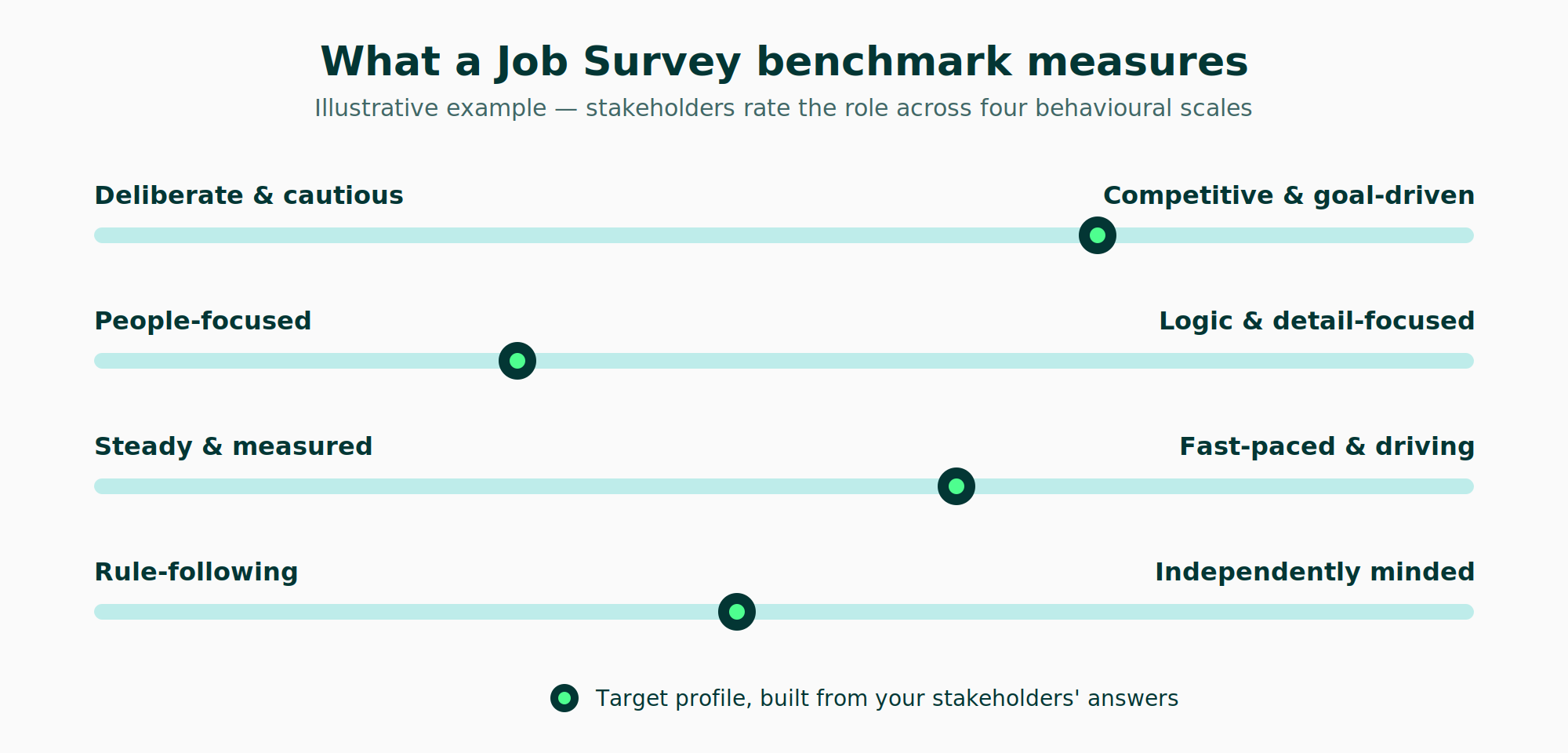
Once everyone has responded, those answers are combined into a single target profile, a benchmark. From that point on, every candidate you consider is measured against that same profile, not against each other, and not against a hiring manager’s gut feel on the day.
There’s no cap on how many stakeholders weigh in when you run a recruitment campaign with Scout Talent. If five different people are involved in the role, all five have the chance to complete one. It’s the same every time you run a new campaign with us, whichever position you’re hiring for next. I’ve used McQuaig products for close to twenty years now, and they’ve reliably helped me make better hiring decisions, both inside our own business and for the clients we work with. That track record is exactly why I’ve used McQuaig products for close to twenty years now, and they’ve reliably helped me make better hiring decisions, both inside our own business and for the clients we work with. That track record is exactly why I built it into how we work as standard, not as an add-on you have to ask for, because it’s the step that makes every decision after it sharper.
What Misalignment Problem Does the Job Survey Solve?
The hiring teams I work with often don’t agree on what a position needs, and their Job Survey results are usually what reveals it.
A hiring manager might picture the position as fast-paced and autonomous. The team lead who’ll work alongside the new hire might be picturing something far more structured and collaborative. Both are reasonable views. Neither has been tested out loud until the survey puts both answers side by side.
I’ve seen this play out with clients, too. One was hiring a marketing manager who’d be responsible across a portfolio of brands and divisions, with stakeholders from each division involved in the decision. One stakeholder pictured someone broad and adaptable, a generalist who could flex across every brand. Another pictured someone more entrepreneurial, comfortable pushing new ideas and driving change. Neither was wrong, but they were describing two genuinely different people. It was only once we saw both answers side by side that the gap became obvious, and it gave the hiring team a real lightbulb moment. The temptation in that situation is to average the two out and look for someone who’s a bit of both, and that’s exactly the wrong move. What actually works is getting the team into a room to agree on which one the role really needs, rather than trying to please everyone.
That gap is not a sign that anything has gone wrong. It’s completely normal, and it happens on nearly every hire where more than one person has a say. What matters is when you find it. Found in week one, in a shared conversation about behaviours and expectations, it’s a five-minute discussion that sharpens the brief. Found three months into a new hire’s tenure, when performance isn’t matching expectations and nobody can quite articulate why, it’s a much more expensive problem, in turnover cost, in team morale, and in the time it takes to run the search again.
This is really the core idea behind the Job Survey: it takes disagreement that would otherwise surface mid-search, or after a bad hire, and catches it before sourcing even starts, when fixing it is nothing more than a conversation.
I’ve also seen what happens when this step gets skipped. We ran a campaign for a finance role without it, the client hired someone, and that person didn’t work out and moved on within months. When we reran the search, three stakeholders, the business owner, the general manager, and the financial controller, all completed a Job Survey this time, and it surfaced differences in what each of them thought the role needed. Working through that disagreement properly, rather than skipping it a second time, led to a hire who’s worked out well. That’s the version of this story I’d rather tell every client upfront, not the one where we find out the hard way.
That’s why I treat this step as an investment rather than paperwork. I’ve made this argument before: an unfilled, or wrongly filled, role really costs an organization far more than people expect, and the number I come back to most is two to four times that person’s annual salary once lost productivity, team disruption and a repeat search are all counted. Fifteen minutes upfront, against a cost like that, isn’t a hard trade to justify, and it’s complimentary with every recruitment campaign you run with us.
How Do You Move From a Gut Feel to a Shared Language?
It’s such a familiar scene that when people ask me for one specific example, I struggle to land on just a single one: two interviewers walk out of a conversation with opposite impressions of the same candidate. One thought they were confident and capable. The other thought they were overselling and light on substance. Both are describing something real, they just don’t have a shared way to talk about it.
Part of why this happens is just human nature. We all make snap judgments about people within the first few moments of meeting them, and it’s hard not to let that shape how we hear everything they say afterward. Confident, at-ease candidates tend to make a strong first impression and get the benefit of the doubt for the rest of the interview, while quieter candidates, sometimes people who’d score lower on sociability but would excel in the role, don’t always get read as generously. Unless you’re deliberately working against that bias, or leaning on a tool built to catch it, it’s easy to miss.
The benchmark from the Job Survey gives the team that shared language. Instead of an interview debrief becoming opinion versus opinion, it becomes a conversation about specific behaviours against a specific standard both interviewers already agreed on before they met the candidate. “Did they show the pace and independence we said this role needs?” is a very different, and far more resolvable, question than “did you like them?”
It also changes what the shortlist itself looks like. Rather than a stack of resumes for you to interpret on your own, you get a shortlist that has already been measured against the profile your own team defined, along with interview questions built specifically to test the areas that matter most for that role. That’s a meaningfully different starting point for an interview than a CV and a hunch.
What’s the Science Behind the Job Survey?
The Job Survey doesn’t test anyone, your team is defining the role, not being assessed themselves. The testing happens later, once a candidate’s own behavioural profile is measured against that benchmark, and that’s where it’s fair to ask what’s backing the result. Plenty of tools in this space produce a polished report without much evidence behind the claims they’re making, and before I built this into how Scout Talent runs every campaign, I wanted to know the difference for myself.
That’s why McQuaig is the one I chose. The Word Survey isn’t some new tool riding on a slick report, it was first published in 1967, and it’s been tested and refined against outcomes for more than 40 years since. It’s backed by data from over 8,100 respondents, and by an independent registration with the British Psychological Society, who don’t hand that out lightly. None of that makes it infallible, but it does mean the number you get back has actually been checked, and it’s a big part of why I’ve stood behind it for close to twenty years.
That’s the difference it makes for you day to day: when you sit down with a shortlist we’ve built, you’re not weighing your gut feel against someone else’s gut feel, every name on it comes with a result that’s been checked by a team we’ve trained to interpret it properly.
The point of all this is not to replace your judgement as a hiring manager. It’s to give that judgement something solid to stand on, backed by a standard we hold every campaign to, so decisions are based on evidence rather than instinct alone.
How Does the Job Survey Fit Into Your Campaign, Step by Step?
The Job Survey isn’t a standalone product, it’s one of the first steps in every recruitment campaign you run with Scout Talent. Here’s how the full process unfolds once your campaign is underway:
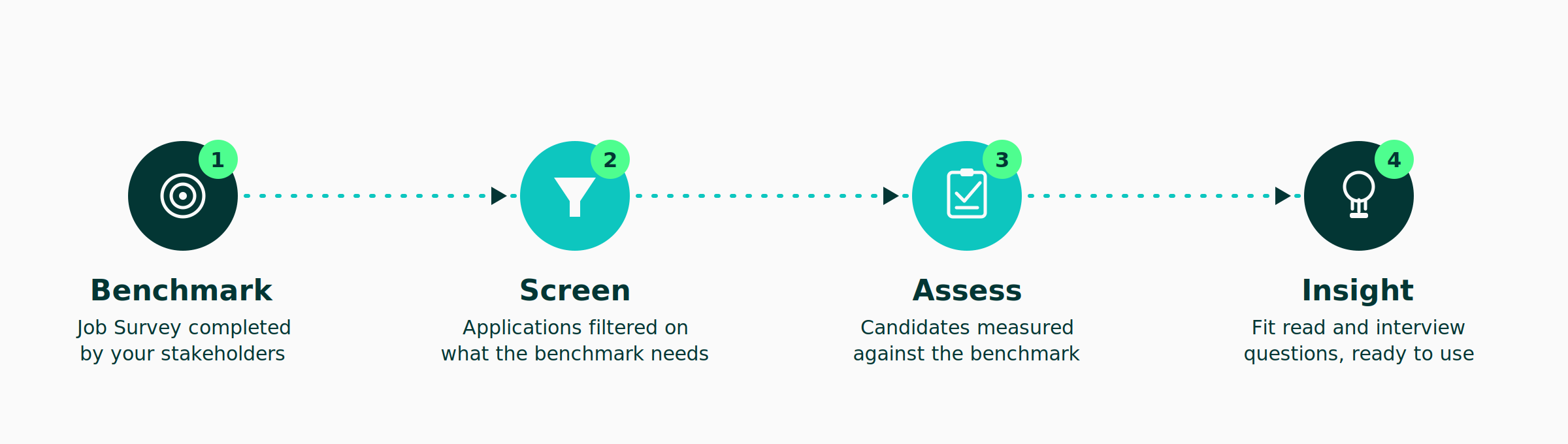
- Benchmark first. Before we start sourcing, the hiring manager and key stakeholders complete the Job Survey. This builds the target profile the entire search is measured against.
- The benchmark shapes how candidates are screened from the start. When your campaign goes live, candidates apply through a branded talent landing page connected to our recruitment software, where you can see everyone who’s applied in one place. The Job Survey results don’t just build your benchmark, they come with specific guidance on what to look for on paper for this particular role, and we can use that guidance to shape the screening questions candidates answer when they apply, so you’re filtering for what matters to the position from the very first application, not just once someone reaches interview.
- Candidates are assessed against the benchmark, not against each other. As candidates progress through the campaign, we introduce the McQuaig Word Survey, a roughly 20-minute behavioural assessment completed by the candidate. It measures temperament across four core scales: drive and how someone takes charge, how they engage with people, the pace they naturally work at, and how they handle structure and detail. Every Scout Talent recruitment campaign includes one Word Survey at no charge, for whichever candidate you choose, typically saved for a strong contender later in the process.
- You get the insight, not just the result. For each Word Survey completed, you receive the candidate’s fit read against your benchmark, tailored behavioural interview questions built specifically to probe the areas that matter most, and guidance on how to manage, coach and onboard that person if they’re hired.
For roles where cognitive speed and problem-solving under pressure matter, sales, coordination, and management roles in particular, we can also add the McQuaig Mental Agility Test, a timed assessment of how quickly and effectively someone processes information and solves problems. Your recruitment specialist can help you decide whether it’s worth adding for the role, it tends to be less predictive for deep-specialist or skilled trade positions, so it’s not something I’d default to for every campaign.
If you’d like more of your shortlist assessed with the Word Survey, whether you’re deciding between your final two or three candidates, or you simply want the extra confidence, that’s something your recruitment specialist can build into your campaign too. It’s not something every hire needs, but it’s there if the decision calls for it.
One thing I want to be really clear on: none of this is about disqualifying someone because of a score. If a candidate ticks every other box but their profile doesn’t fully match the benchmark, you still interview them, you simply use the survey as a guide for where to probe harder in that conversation. This is a tool that sharpens your judgement, not a substitute for it.
What Does This Look Like in the Real World?
That’s the process laid out step by step, but I’d rather show you our own experience than someone else’s, since it’s part of why I insist on it now. A while back, we went through about twelve months where we weren’t actively recruiting for our own sales team. When we picked hiring back up, the process had gone stale along with it: we hadn’t run a fresh Job Survey with the right stakeholders, we hadn’t rebuilt alignment on what the role needed, and we weren’t measuring candidates against a profile with the Word Survey before we interviewed them. Looking back, I don’t think everyone we placed in that stretch ended up in the right seat, and it’s a big part of why I now treat this as non-negotiable, for our own hiring and for every campaign we run for a client.
This financial year, we started recruiting more heavily again for sales roles in both Brisbane and Vancouver, and this time we ran the full process properly from the start. The person we brought on in our Brisbane office had a Word Survey profile that matched closely to what the Job Survey said the role needed, and he’s doing well and happy in the role. It’s exactly the outcome I’d expect when the process is followed the way it’s meant to be, which is exactly why it’s built into every campaign we run, including our own.
That’s the pattern I see generally: the earlier a hiring team agrees on what “great” looks like for a specific role, the more confident, and the more consistent, every decision after that becomes.
Where Should You Go From Here?
Where you go from here depends on whether you’re already running a campaign with us, or just exploring how we work.
If you’re already running a campaign with us and a Job Survey request has landed in your inbox, the most important thing you can do is complete it promptly, and get your co-stakeholders to do the same. It’s one of the highest-leverage 15 minutes in the whole campaign, and it shapes every shortlist, every interview and every reference check that follows. If anything about the survey itself is unclear, your recruitment specialist is the right person to ask.
If you’re exploring how we run campaigns and this is your first look at how we work, this is a fair example of what “on-demand recruitment partner” means to me in practice. We don’t hand you a stack of resumes and leave the interpretation to you. We build a benchmark with your team first, then give you access to your own campaign in our platform :Essentials, every applicant, and a shortlist already measured against that benchmark, complete with tailored interview guides, all built into the campaign at no extra cost.
There’s another side to this worth saying plainly: getting it right isn’t only good for you as the employer, it matters just as much for the candidate. Being placed into a role that isn’t the right fit is a bad outcome for everyone, the candidate ends up leaving a job they only just accepted, and nobody wins. When we use these tools properly, we’re not just looking out for your side of the hire, we’re helping make sure the person on the other side of it ends up somewhere they can succeed.
Better recruitment starts with agreeing on what “better” actually looks like for the role in front of you. The Job Survey is how I make sure that agreement happens before the search does.
Better recruitment. Stronger organizations. Hire better, starting today.