4 Onboarding Mistakes to Avoid for a Seamless New Hire Experience

Learn 4 onboarding mistakes to avoid and its solutions on how to set up a positive onboarding experience.
Easy-to-action insights to help you hire top tech talent

A challenging hiring market means you need to think outside the box, get some easy-to-action insights on how to hire top tech talent from specialists.
11 Secrets For A Successful Onboarding Process

11 tips to help you set the right tone with your onboarding process and make team members feel like they are equipped for success.
How a Best-of-Breed Platform Can Support High-Volume Retail Recruitment

Managing recruitment in the retail industry is an ongoing challenge. HR teams in retail organizations are tasked with hiring a constant, high-volume flow of new retail workers while managing a turnover rate and seasonality that is simply not present in any other industry. In Canada, the retail industry has one of the youngest workforces, with more workers under 24 years old than most other industries. A young workforce can lead to challenges when it comes to retention. According to EY, the younger the employee, the less likely they are to stay with an employer in the long term. Retail HR teams must also manage their mass recruitment in a way that identifies the best candidates cost-effectively because modern-day retail also has to compete in profit with its online retail competitors. But managing an ongoing and constant flow of new hires can put a strain on HR teams and result in rushed or unsystematic onboarding processes; in turn, affecting revenue and productivity while increasing turnover. In order to achieve their talent acquisition goals, retail recruitment teams should utilize the best tools available on the market. This is Where a Best-of-Breed Talent Acquisition Platform Helps. A best-of-breed (BoB) platform allows retail talent acquisition teams to build a suite of the best software modules for their needs, available in a one-stop source. The Scout Talent platform, for example, allows retail teams to have the best software for tracking and managing candidates, onboarding new hires and keeping passive candidates engaged. These software modules can be easily integrated to keep your talent acquisition data and processes in one place. Comprehensive ATS and Recruitment CRM Applicant tracking systems (ATS) and recruitment customer relationship management (CRM) tools are useful for all industries. They allow HR teams to better track, manage, evaluate, and engage with candidates. When dealing with so many candidates, utilizing an ATS and recruitment CRM such as Scout Talent :Recruit will drastically reduce errors, streamline the hiring process, and provide a better candidate experience. These benefits are highly impactful when working in the retail industry, as it makes recruiting en masse much easier and mitigates common challenges in retail processes, such as ghosting (where a candidate disappears because they found a job elsewhere while they were applying and interviewing with you), as your smooth recruitment process and candidate care can be enough to convince a candidate to go with your organization. :Recruit, Scout Talent’s premier ATS and recruitment CRM module, has a range of features that support retail recruitment, including: Quick job posting (with branded talent landing pages) to multiple job boards; Easy communication with candidates, through branded email templates, batch communications and event scheduling; Automations to screen applications and identify top candidates in your talent pool; and, The ability to build hiring workflows that keep your entire team informed and allow for collaboration. These features empower retail organizations to hire at high volume efficiently, and showcase why :Recruit is a best-of-breed ATS and recruitment CRM. But recruitment is about more than just hiring new people – it also encompasses maintaining a talent pipeline for future hiring needs, and managing retention. That’s why :Recruit is supplemented by :Engage and :Onboard. Reducing the biggest problem in retail: high turnover Often in retail, recruitment can swing between extremes. In some hiring drives, there may not be enough quality candidates whilst in others, you may not have enough budget to hire all the stellar candidates. If your recruitment model is reactive, both of these scenarios will pose a problem because you won’t have a time-efficient way to source candidates, store their data for future hires, or recruit them successfully. Combat these challenges and cater to future hiring needs before they pop up with :Engage. Through Scout Talent’s :Engage software module, you can build and nurture talent pools, strengthen your employer brand, and recruit passive candidates. Learn more about :Engage and how you can secure your talent pipeline here. Equally as important to attracting and hiring talent is retaining your organization’s new retail hires. One of the most critical steps to reducing turnover in the retail industry is ensuring new team members are onboarded properly. This is a common difficulty in retail, as the environment is fast-paced and keeps every team member busy, but studies have shown that organizations who have a strong onboarding process are more likely to retain talent. The Scout Talent platform offers an onboarding solution through the :Onboard module, helping you to maintain your new hires for longer and maximise their productivity. Discover how :Onboard can help you with your employee retention. The best part of a BoB platform is that you can work with our partners to integrate other modules that may suit your organization’s needs better. For example, our partner, intelliHR, can help with your onboarding; alternatively, if you are already working with intelliHR, you can easily integrate the Scout Talent platform to complement it. Designed to reduce employee turnover rates (particularly in high-turnover industries such as retail), intelliHR has tools and capabilities that help to dramatically improve engagement – all in ways that are easy to use and perfect for mass onboarding new retail hires. These tools help to reduce admin tasks and optimize the employee experience even before their first day. Some key features of intelliHR’s onboarding software include: Welcome systems for new hires; Automated workflows; Wellness check reminders; Monthly check-in reminders; and, Performance management tools. Click here to learn more about intelliHR and how it can empower your onboarding process. You can also read more about intelliHR and how it integrates with Scout Talent in our Q&A with the intelliHR team: {{Link}} Add this link once the Q&A article is live. End-to-end talent acquisition in the retail industry can be easier Retail organizations all throughout Australia can benefit from powerful software that is available through a single, collaborative source. Drive successful outcomes and productivity in HR teams through a BoB platform that enhances and streamlines the hiring and onboarding process. If you’d like to discuss implementing a BoB platform
The Talent Scout Episode 69: Is A Dress Code Still Relevant?
This episode of The Talent Scout recruitment podcast discusses how many workers wear pyjamas while working from home.
LinkedIn Limited Listings Integration with Scout :Recruit

Scout Talent now offers LinkedIn Limited Listings, a free advertising solution that is fully integrated and automated within Scout :Recruit.
Here’s Why Recruiters Should Be Excited to Return to the Office

It’s safe to say that the thought of returning to an office environment is a daunting one. Since early 2020, the daily routine of professional workers has changed significantly. The hustle and bustle of the daily commute has been replaced by a relaxing journey from bed to desk. You’ve been getting more sleep, saving money
Avoid Costly Mis-Hires: How Local Governments Can Reduce Hiring Risk

Taking on new employees in local government can have its challenges. While recruitment always carries some risk, the wrong hire can be particularly devastating for smaller Councils. Here how local governments can reduce hiring risk. New hires make us wonder, can they work well with our existing team? Will they show the dedication required for their role? Will they leave after a few months? While screening and onboarding new employees can be costly and time-consuming, following hiring best practices can help you reduce the odds of making the wrong hire, and increase the likelihood to place the right person in your role. Here are six tips about how local governments can reduce hiring risk. 1. Define the role Attracting the right person means understanding your organisation and role requirements inside and out. Establishing set criteria before your start advertising helps you stay focused when you do start to receive applications. Check out our article: “Are you recruiting purple squirrels? (How to rethink your selection criteria)” Seek input from key people invested in the role: your hiring manager, and whoever the role’s new manager and team members will be. Write down the list of duties your new hire will be required to perform and the skills they need. Use experience and qualifications to narrow down your talent pool. Then, tailor your recruitment advertisement accordingly. Culture is important in local governments, both for individual teams and your organisation as a whole. In your recruitment advertisement describe the work environment your new hire can expect. Sharing details about the way your organisation operates (and excels) will help both you and your candidates decide if your role is the right fit. Check out our article and podcast episode of The Talent Scout: How to pick a winning candidate 2. Use the power of referrals If you’re still wondering how local governments can reduce hiring risk, remember that you can reduce hiring risk through referrals. Referrals are one of the best ways to source talent you can trust. It’s faster, and often cheaper than traditional methods. To increase the number of referrals you receive, consider putting in place an employee referral program. These programs save time and money, as you won’t need to spend hours wading through resumes or waste money on job postings that don’t attract the right candidates. Your current team knows what it takes to be successful, and they can be a fantastic asset when it comes to finding new talent. People who already work in your Council will typically refer people with similar work ethic. So if you have a high-calibre team, you’ll attract high-calibre talent. Instead of spending thousands of dollars on recruitment advertisements, you can spend as little as a quarter of that amount through referrals – costs associated with referrals typically come from employee compensation from successful referrals. This can vary based on your organisation’s needs. 3. Use smart interviewing techniques Interviewing is not only an important opportunity to gain direct insights into your candidates, but having the right processes will save you valuable time and resources. Develop a list of behavioural and skills-based interview questions to screen candidates over two-way recorded video interviews or over the phone before inviting them for a face-to-face interview. Use your list of interview questions to keep interviews fair and consistent. While remote interviews are an investment, they save you time in the long run. By recording initial interviews (after obtaining permission from interviewees), you can share it with multiple team members to gain their feedback on which candidates to progress with. Gaining their insights can allow you to make a more informed decision. When it comes time to the face-to-face interview stage, many Councils invite team members to conduct a panel interview. Each interviewer takes turns to ask questions individually, the remaining panel members have time to listen to what the candidate is saying and observe their body language. Dividing the responsibilities gives both strong and weak interviewers the chance to ask questions, increasing the likelihood that all appropriate questions will be asked. Panel interviews reduce the risk of personal bias and ensure the validity of interview findings. It’s also an opportunity for candidates to interact with their potential coworkers, and gain a better understanding of the role as it’s seen from different employees’ perspective. 4. Check references After you’ve found a great candidate, it’s time for reference checks. Ask referees to confirm: Education, certifications, qualifications and skills Title or position in their previous role More information about the nature of their former duties and personality. Reference checks help you to narrow down your pool of candidates and reduce hiring risk, especially if you’re torn between several applicants who all interviewed well. Managers eliminate 21 per cent of applicants after speaking with their professional contacts (OfficeTeam). Learning about an applicant’s professional background from a direct source can be a great way to determine if they’re a good fit. Cross-reference contact information through independent research. If they provide a contact number for their supervisor at a former place of employment, look up the organisation. 5. Establish trial periods Many local governments engage in trial periods with new hires. This allows you to see how they perform, without making a commitment to permanent employment. It’s an opportunity to see how they interact with the rest of the team and whether they’ll be a successful long-term fit or not. It can also save you money, and give you the time and proof you need to assess your new hires’ abilities – beyond their resume and interview. 6. Conduct checks Background and pre-employment checks give you the peace of mind to confirm your hiring decision, particularly in local government roles where employees are trusted with confidential or sensitive information. This can save your organisation from hiring mistakes that could lead to misconduct or fraud. Checks give you access to employment history, police checks, traffic checks, financial checks and more. Specialist support from a recruitment services provider like Employment Office gives you fast, easy-to-understand reports
10 Steps For Remote Hiring: Find Great Candidates Without Face-To-Face Interviews

Remote hiring is a great opportunity to find great candidates without face-to-face interviews. Follow these 10 steps to improve your remote hiring outcomes.
Product Update: Make multiple offers with ease
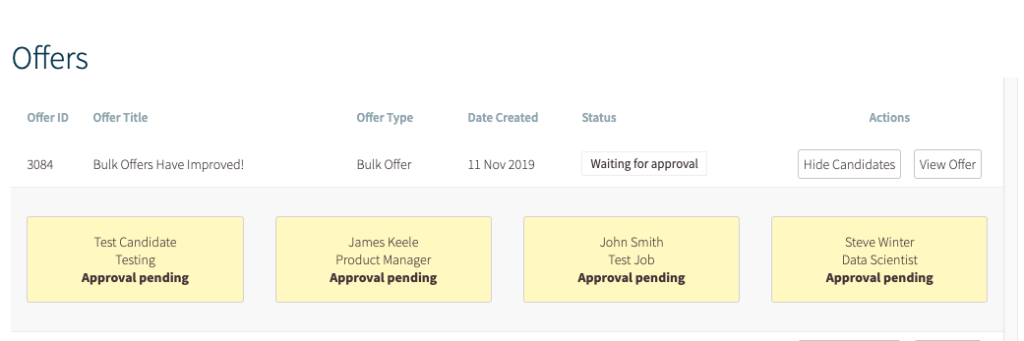
Do you make multiple offers? We’ve recently enhanced the Bulk Offer functionality as part of Scout Talent: Onboard. While :Onboard has always facilitated the ability for hiring managers and internal recruitment teams to send offers to multiple offers, the process is now easier than ever. Here’s how. When approving and sending offers to candidates, you can now switch between previews for each candidate being offered a position: A new placeholder allows you to send a list of candidates in an email to approvers. After you’ve sent offers to candidates, you can now view the status of each offer: As each candidate responds, the card on the offers page updates to reflect the results: You can then individually attend to each candidate’s response.