
You’ve just wrapped up an interview, and the candidate was terrific. Confident, articulate, said all the right things. Everyone in the room felt good about them. Have you ever hired that person, and watched the fit fall apart within months?
That’s the gap between a great interview and a great hire. An hour in a room tells you how someone performs under exactly those conditions, on their best behaviour, prepared, aware they’re being watched. It tells you almost nothing about how they’ll work once the interview’s over and the job starts.
I recently wrote about the McQuaig Job Survey, the 15 minutes your team spends agreeing on what a role needs before sourcing starts. This is what comes next: once you know what you’re looking for, the Word Survey is how you find out whether the person in front of you is actually it, not just how well they interviewed for it.
Key Takeaways
Before diving in, here’s what you’ll learn:
- What a Word Survey actually is, and how its four behavioural scales are built to be read directly alongside the role’s Job Survey benchmark
- Why most hiring teams overestimate how well an hour-long interview predicts job performance, and what the research shows works better instead
- How the Word Survey and Job Survey work together as one connected process, not two separate decisions
- What’s backing the assessment’s validity, and why a mismatch on one scale doesn’t disqualify a candidate
- How the Word Survey fits into a Scout Talent campaign step by step, from completion to the tools it hands you before you walk into the interview
What’s a Word Survey?
A Word Survey is a short assessment a candidate completes, roughly 20 minutes, that reveals how they naturally work, lead, and collaborate, not just how they come across for an hour in an interview room.
Where the Job Survey asks your team to define the role, the Word Survey turns that same lens on the candidate. It measures temperament across four core scales: drive and how someone takes charge, how they engage with people, the pace they naturally work at, and how they handle structure and detail. Those aren’t abstract personality labels, they’re the same behavioural language your team used to describe what the role needs, which is exactly the point. It means a candidate’s result isn’t just a description of who they are, it’s a direct comparison against what you’re looking for.
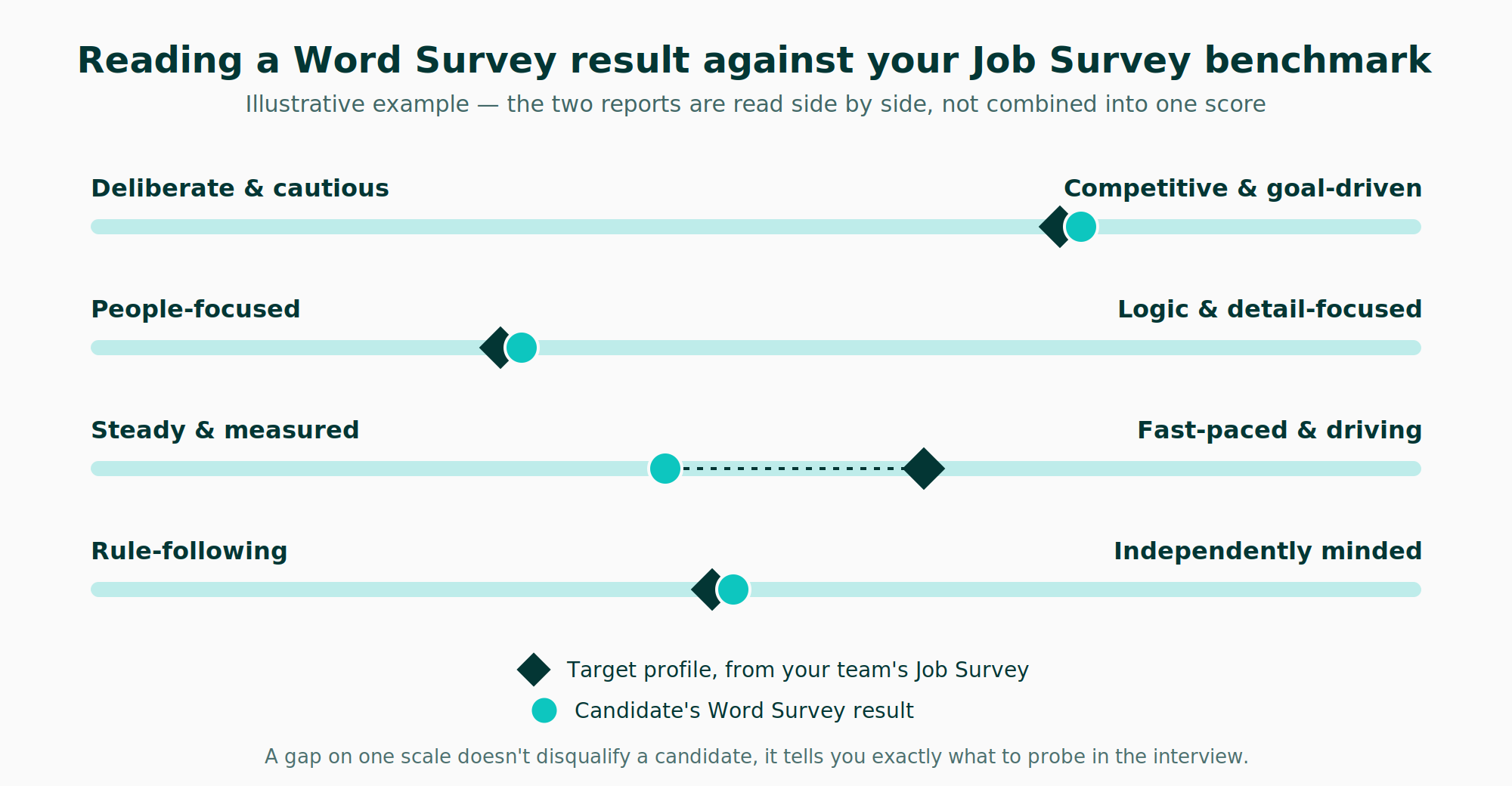
The result is built around the same behavioural language your team used in the Job Survey, which means it’s built to be read alongside it: how closely this specific person’s natural style lines up with what the role needs, and where it doesn’t. Alongside that, you get tailored interview questions built to probe the areas worth a closer look, coaching and management tips for if they’re hired, and guidance for onboarding them in a way that suits how they work, not a generic checklist.
Every Scout Talent recruitment campaign includes a complimentary Word Survey for your top contender, the candidate you’re most seriously considering, before you sit down for that conversation. It’s one more layer of certainty before you make a decision that’s expensive to get wrong, not an extra step for its own sake If you want more of your shortlist assessed, whether you’re deciding between your final two or three candidates, or you simply want the extra confidence, your recruitment specialist can build that into your campaign too.
What Problem Does the Word Survey Solve?
Gut feel has its place, but the research shows why it shouldn’t be the deciding factor. A major 2022 meta-analysis (Sackett, Zhang, Berry & Lievens, Journal of Applied Psychology), one of the most rigorous reviews of hiring research available, found that unstructured interviews (the free-flowing, conversational kind most hiring teams run by default) have a predictive validity of around 0.19 out of 1 for job performance. Structured interviews, built around a consistent set of job-relevant questions asked the same way every time, come in at 0.42, more than double. None of this means a structured interview guarantees the right hire, its predictive power still shifts with the role and the context, but the pattern itself has held up across decades of research: the kind of interview most teams run by default is the one the research consistently shows predicts job performance less reliably, and the fix isn’t complicated. Ask better, more consistent questions, which is exactly what a Word Survey result hands you before you walk into the room.
A confident, well-rehearsed candidate can walk into an interview, say the right things, and leave a strong impression, then genuinely struggle once the role’s actual demands kick in. A quieter candidate can undersell themselves in an hour-long conversation and go on to outperform everyone’s expectations. Neither outcome is unusual, and neither is easy to catch on instinct alone.
Part of that comes down to plain human nature. People form snap judgements about each other within the first few moments of meeting, and it’s hard not to let that first impression colour everything said afterward. A confident, at-ease candidate tends to get the benefit of the doubt for the rest of the interview. A candidate who’s quieter, more measured, or simply nervous on the day doesn’t always get read as generously, even when their working style would suit the role just as well or better.
That bias shows up in a few specific, recognizable ways in most hiring processes:
- Over reliance on interview impressions. How someone performed for an hour becomes the main evidence for a decision that will shape a working relationship for years.
- A limited view of behavioural style. A resume shows what someone has done. It says very little about how they go about doing it, under pressure, with a team, on a tight deadline.
- Candidates who look good on paper but don’t thrive in the role. The qualifications and experience checked out. The fit didn’t. Those are two different questions, and most hiring processes only really test the first one.
- No real insight into how a new hire will affect the team around them. Even a strong individual performer can throw off a team’s dynamic if nobody thought about how their working style would sit alongside everyone else’s.

I’ll be honest, I don’t look at a Word Survey result and let it colour how I perceive someone in an interview, but having seen it beforehand does help me know what to listen for. The mismatches I see are rarely dramatic. Someone whose natural profile leans more analytical, less sociable, and more compliant might still walk into an interview with a big smile and an outgoing handshake, because that’s what an interview calls for. Once they’re in the role full time, they tend to settle back into something closer to their natural style, a little quieter and more measured than the version who showed up to interview.
That’s exactly why this isn’t, and shouldn’t be, the only thing a hiring decision rests on. I’ve seen people new to using it take a result too literally and let it do more deciding than it should. A high score on one trait doesn’t mean someone will behave that way in every room they walk into. I’m naturally high on dominance myself, competitive, goal-oriented, with a strong sense of urgency, but that doesn’t mean I walk into a room full of strangers and make the whole conversation about me. People adapt. A result tells you a tendency, not a guarantee, and no candidate should be ruled out, or in, on the strength of a score alone.
None of this is a small thing to get wrong. A bad hire is commonly estimated to cost two to four times that person’s annual salary once lost productivity, team disruption, and a repeat search are all counted, and a decision built on an hour of impressions is exactly the kind of decision that goes wrong in ways nobody sees coming until it’s already expensive.
The risk isn’t limited to the individual hire, either. Bring someone onto a team without understanding how they’ll work alongside the people already there, and you can end up with a new hire who’s technically capable but quietly at odds with how the team operates, which shows up later as friction nobody can quite name.
How Does the Word Survey Build on the Job Survey?
The Job Survey and Word Survey aren’t two separate decisions, they’re two halves of the same one. The Job Survey defines what the role needs, before anyone applies. The Word Survey gives you a picture of how the person in front of you naturally works, once someone has, and it’s built to be read against that same definition.
Without that connection, a Word Survey result is just an interesting personality snapshot, mildly useful, but disconnected from the job it’s meant to inform. Reading alongside the Job Survey, it becomes something sharper: not ‘is this person impressive,’ but ‘does this specific person’s natural style line up with what this specific role, as your own team defined it, requires.
That distinction matters more than it might sound. Two hiring managers can look at the same candidate and reach opposite conclusions, one drawn to their energy, another put off by it, and both are really just describing personal chemistry, not job fit. A benchmark removes that variable from the equation. Instead of comparing candidates to each other, or to whichever interviewer happened to click with them, you’re comparing each of them to the same standard your own team agreed on before sourcing even started.
That consistency is worth protecting. A hiring decision made on chemistry alone is exactly the kind of decision the research already covered here shows is less reliable than one built around a consistent standard, and when it goes wrong, a bad hire is commonly estimated to cost two to four times that person’s annual salary once the fallout is counted. Comparing every candidate against the same fixed standard, instead of a moving target of personal impressions, is a far more reliable way to make a call that expensive.
What’s the Science Behind the Word Survey?
One question I get asked honestly and often: can candidates just tell the survey what it wants to hear?
Not easily, and here’s why. The Word Survey compares a candidate’s natural style against their situational, or “presenting,” style, the version of themselves they think a hiring team wants to see. A mismatch between the two is itself a useful signal. Someone sophisticated enough to consciously manage that presentation throughout a 20-minute assessment is often telling you something relevant about how deliberately they manage themselves in general, including in an interview.
There’s no pass or fail. Nobody is excluded from a shortlist purely on the basis of a score. It’s a read, not a gate, and the judgement about what to do with that read stays entirely with you.
That gap isn’t always about someone managing an impression, though. I once hired a candidate whose situational and natural profiles were genuinely quite different, and it caught my attention at first. Once we talked it through in an interview, the reason became clear: they’d adapted their natural style to fit a very different workplace culture earlier in their career, and that adaptation was still showing up in how they presented. Their natural profile turned out to be the better match for the role, and once they were in it, they settled into that natural style quickly, which is a far easier way to work than holding up an adapted version of yourself indefinitely.
A gap like that can also show up around a life change, a new baby, a recent job change, or simply not being happy where someone currently is. None of that means a result is wrong. It just means a gap is always worth a conversation, not an assumption.
There’s a reason a tool built this way tends to outperform a generic personality quiz: the same 2022 research found that personality measured in job context, how someone behaves at work specifically, rather than in general, roughly doubled in predictive validity compared to general personality measures. The Word Survey’s four scales are framed against that same job-specific grounding, and it’s not a new idea riding on a slick report, it was first published in 1967, tested and refined against real outcomes for more than 40 years since, backed by data from over 8,100 respondents and an independent registration with the British Psychological Society. That’s why McQuaig is the tool I’ve stood behind for close to twenty years, and the same standard I hold everything we build into a campaign to.
How Does the Word Survey Fit Into Your Campaign, Step by Step?
The Word Survey isn’t a standalone report to file away, it’s one step in a connected process. Here’s how it plays out once your campaign is underway:
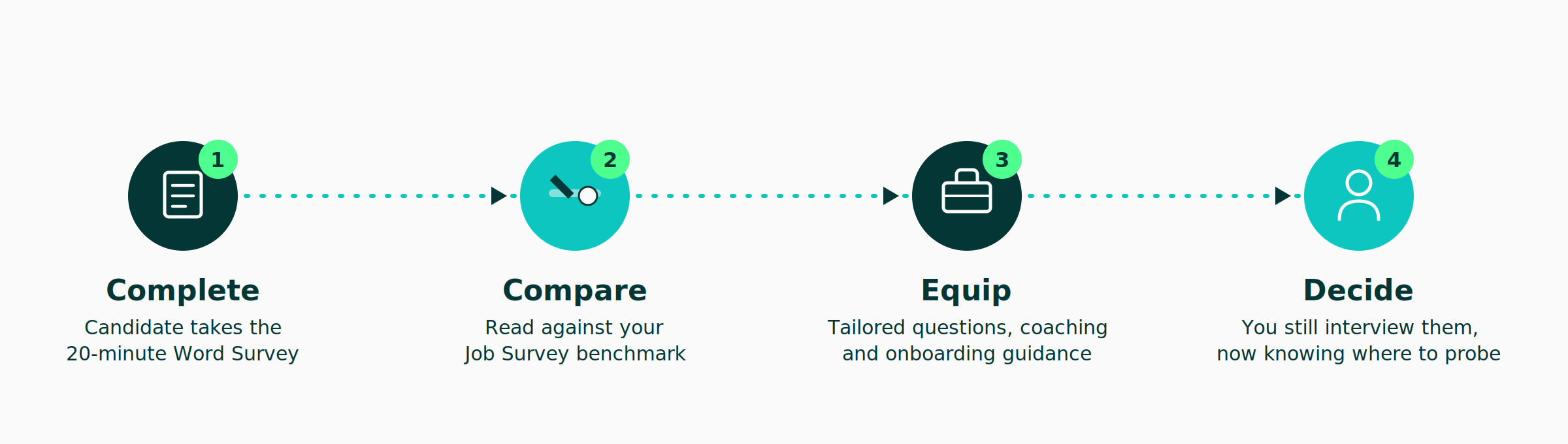
- The candidate completes it. Once you’ve got a strong contender, typically later in the process rather than for every applicant, they complete the Word Survey. It takes about 20 minutes, there’s nothing to prepare for, and it isn’t the kind of test you study for, which is exactly why it tends to reveal how someone naturally operates rather than how well they’ve rehearsed for an interview.
- You get a result built to be read against your benchmark, not a generic personality snapshot. A generic personality report tells you what someone is like in general. This isn’t that. Their results use the same behavioural language your team used in the Job Survey, so when you read the two side by side, you can see how well this specific person’s natural style lines up with what this specific role needs, scale by scale, not a broad character sketch that could apply to any job.
- You get the tools to act on it. This is where a result stops being information and starts being useful. Instead of walking into an interview with a generic question like “tell me about a time you led a team,” you get a question built around what the result actually flagged, say, less natural drive under pressure than the role calls for, so you ask specifically about how they’ve handled high-pressure deadlines in the past. Alongside that, you get guidance on how to manage and coach them if they’re hired, and onboarding insight so their first weeks are shaped around how they work, not a generic checklist every new hire gets regardless of fit.
- You decide what it changes. A result that doesn’t fully match the benchmark isn’t a disqualifier. If a candidate ticks every other box, you still interview them, you just know exactly where to dig deeper in that conversation.
What Does This Look Like in the Real World?
The steps are straightforward enough on paper. What matters is what happens once a result actually lands in front of you.
I can tell you about a hire where I didn’t lean on it enough, and I wish I had. We were considering a candidate who scored very high on drive and taking charge. Against my better judgement, I told myself the other strengths they brought would make up for it, and we hired them. Once they started, it became clear the role needed someone stronger on deliberation and caution than they were ever going to be, and it didn’t work out.
Looking back, the tool had already told us what we needed to know. I just didn’t use it properly. There were interview questions sitting right there, built specifically to probe that exact mismatch, and I didn’t use them to dig deeper before we made the offer. It was a good reminder that the Word Survey earns its keep when you actually lean into what it flags, not when you glance at it and move on. I’m still not saying a result should ever be make or break on its own, but in this case, it was right, and I should have listened more closely.
That’s the pattern I see generally: the more a hiring decision rests on something other than how someone performed for an hour in a room, the more consistently it works out for everyone involved, the business and the candidate both.
Where Should You Go From Here?
Where you go from here depends on whether you’re already running a campaign with us, or just exploring how we work.
If you’re mid-campaign and deciding who to run a Word Survey on, my advice is simple: use it on whoever you’re seriously considering, not just your frontrunner. The value isn’t in confirming what you already believe, it’s in catching what you don’t yet know.
If you’re exploring how we run campaigns and this is your first look at how we work, this is what an on-demand recruitment partner means to me in practice: a shortlist that’s been measured against something real, not just how each person happened to present on the day you met them.
Better recruitment doesn’t stop at agreeing on what the role needs. It means checking that agreement against the person you’re about to hire, before you make the offer, not after.
Better recruitment. Stronger organizations. Hire better, starting today.