
Are you confident you’re tracking the right recruitment metrics in line with your organization’s strategies and goals? HR and recruitment marketing software company PageUp shares why Applicant to Hire Rate is a critical metrics to track, and steps to take if you’re receiving too many or too few applications.
COVID-19 has changed the recruiting game. With lots of talent on the market right now, you’d think finding people to fill roles would be easy. That’s not always the case.
If you’re receiving too many applications for open roles or too many of the wrong kind of applicants, this is a red flag. The good news is, there is a metric people often overlook that can address this problem.
When we start the recruitment process, we have one end goal: to find and hire the right person for the role. To get there, we start with applications. But do you know how many applications you need to find one successful hire? If you’re receiving too many, you’re wasting time and effort sifting through unsuitable resumes. Too few, and you might not have the skills or talent you need for the role.
To determine your hiring sweet-spot, let’s look at one of the most crucial recruitment metrics: your Applicant to Hire Rate. That is, the Percentage Applicants to Hire.
Percentage Applicants to Hire
Percentage applicants to hire is the total number of hires divided by the total number of applications for the role or position. Think of it as reverse engineering from the hire that you made – how many applications were required to find that person? You can calculate your percentage applicants to hire using the following formula:
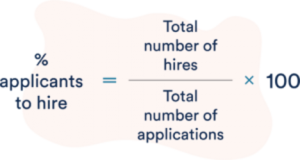
The applicant-to-hire ratio is critical for organizations to understand now and as the COVID-19 pandemic evolves. The lower your applicant-to-hire rate, the fewer applicants you’re saying ‘yes’ to. In these times, it’s about quality, not quantity – how many applicants do you need to secure a hire? If you’re taking high volumes of applicants through the recruitment process, you may not be able to provide a personalized, high-touch experience to all of them.
Many organizations are not hiring right now. During an economic contraction, there are fewer roles being advertised and high job losses, stand-downs and furloughs.
But what happens when you open up the recruitment cycle again? It’s likely that any job opening will attract more applicants and your applicant-to-hire rate will increase.
If your application volumes are high, your applicant to hire ratio will be lower. A low applicant to hire ratio is not something to be desired: it means you’re putting lots of people through the screening process, but only hiring a small fraction of them.
Ask yourself:
- Are my job ads targeted enough?
- Do I know my most effective talent sourcing channels?
- Do I need to revisit my sourcing methods to identify and focus on the talent I need?
Assessing which channels hires are coming from is important, but if you’re inundated with wrong-fit applicants, you may need to work closer with your hiring managers to understand the role requirements and be more targeted in your hiring.
How does your rate compare?
According to global PageUp research and customer benchmarking, on average for every 100 applications received, four people are hired. Put another way, on average globally and across all industries, 25 applications are needed for 1 hire.
The exact numbers vary based on the industry. So far in 2020, Higher Education has hired 7% of applicants (down from 8% in 2019). Retail in 2020 has only hired 3% of applicants, compared with last year where 4% of applicants were hired. Finance has also reduced its hiring, with only 3% of applicants hired this year, in comparison to last year’s 4%.
These are changing times. If you find your organization’s metrics differ to the benchmark, there could be a host of new reasons. The important thing is for you to discover the volume of applications required to find the right person for the role.
If you’re receiving high volumes of applications, ask:
- Are you an employer of choice?
- If you are, a high volume of applications is to be expected, especially with more talent on the market right now.
- If you’re not usually an employer of choice, are your job ads targeted enough?
- Can you add any screening questions at the start of the application form to sift out non-valid applications?
- Are you leaving job ads open for too long?
If you’re receiving a low volume of applications for a role, ask:
- Are your job ads reaching and engaging the correct audience?
- Do your job listings need to be open for a longer period of time?
- Is your application form too long? Is it mobile optimized?
- Is your careers site easy to navigate and engaging? This is where active and passive job seekers go to find out more about your organization.
- Do you need to improve your employer branding?
- Are you providing a seamless and easy candidate experience?
Knowing how to track and optimize your applicant-to-hire rate will help you to cut unnecessary screening costs and ensure you’re providing a high-touch, personalised experience for all applicants.
Of course, recruitment technology goes a long way in automating and improving the candidate experience with less recruiter intervention, allowing you to recruit at-scale – but being targeted and strategic in your job search will always lead to better end-results.