
Key findings
- Hiring managers and candidates see the same process differently. 97% of hiring managers say their job ads are accurate, but only 48% of candidates agree.
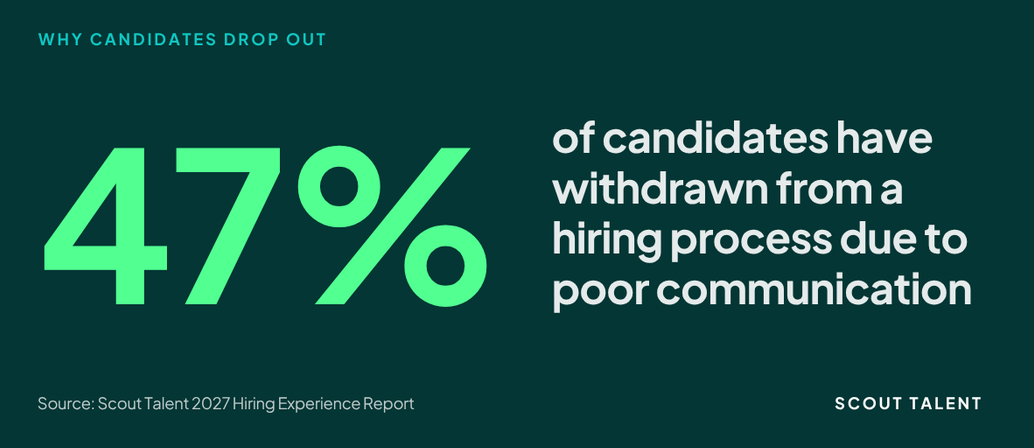
- Communication is the biggest reason candidates drop out. 47% have withdrawn from a hiring process because of it.
- Candidates are more open to AI than employers expect, as long as they know when it’s used and a person makes the final call.
- AI-polished applications are now the norm, so clear ground rules matter more than detection tools.
- Two in-depth interviews, built around a real task, tell you more than extra rounds.
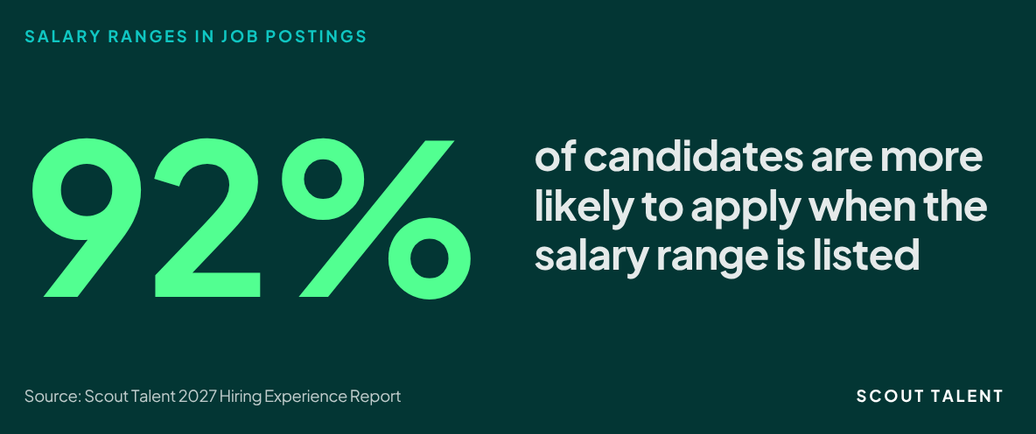
- 92% of candidates are more likely to apply when the salary range is listed.
- Most candidates expect an offer within one to four weeks, so sharing your timeline upfront closes much of the gap.
Source: Scout Talent’s 2027 Hiring Experience Report, a survey of more than 500 candidates across Canada, the US, Australia and New Zealand, conducted in September 2026, alongside hiring managers. See About the research below.
It’s a strange time to be hiring. Many organizations are receiving more applications than ever, yet almost every HR professional I speak with tells me the same thing: it’s no easier to find the right people than it was five years ago.
I hear it in client meetings, at industry events and over coffee. And I understand why the first instinct is to spend more on job ads and try to reach more people.
So this year, we decided to ask candidates directly. In our 2027 Hiring Experience Report, more than 500 people across Canada, the US, Australia and New Zealand told us how job hunting really feels right now, and we put the same questions to a group of hiring managers. Their answers point to seven hiring trends 2027 will bring, and the biggest opportunities aren’t in reaching more people. They’re in the experience candidates have once they find you, which is something every hiring team can shape.
In my view, that’s the shift most HR teams are underestimating. AI has made it easy to apply, so volume is rarely the problem anymore. Trust is. Teams have more applications than ever and less confidence that any of them reflect the real person, and candidates feel the same way about employers. They’re unsure the ad is accurate, that a real person will read their application, or that anyone will get back to them. In 2027, the organizations that win won’t be the ones reaching the most people. They’ll be the ones candidates trust enough to stay in the process with.
That’s genuinely good news. Candidates aren’t asking for bigger budgets or the latest technology. They’re asking for clear communication, honest expectations and a real person at the moments that matter. Get those right in 2027, and you won’t just fill roles. You’ll become the employer the best candidates choose.
In this article
- What Is the Hiring Perception Gap?
- Why Do Candidates Drop Out of Hiring Processes?
- How Do Candidates Really Feel About AI in Hiring?
- How Is AI Changing Job Applications?
- How Many Interviews Should a Hiring Process Have?
- Should Job Postings Include a Salary Range?
- How Long Should a Hiring Process Take?
Plus: How to prepare, About the hiring report, and FAQs
1. What Is the Hiring Perception Gap?
The hiring perception gap is the difference between how hiring teams believe their process feels and how candidates experience it. In 2027, it’s one of the biggest hiring trends to watch, because it’s often invisible from your side of the desk.
Here’s a quick test: do your job ads accurately reflect what a new hire will do day to day? If you said yes, you’re in good company. In our 2027 Hiring Experience Report, 97% of hiring managers said their job ads are usually or always accurate. On the other hand, only 48% of candidates said the same about the ads they see.
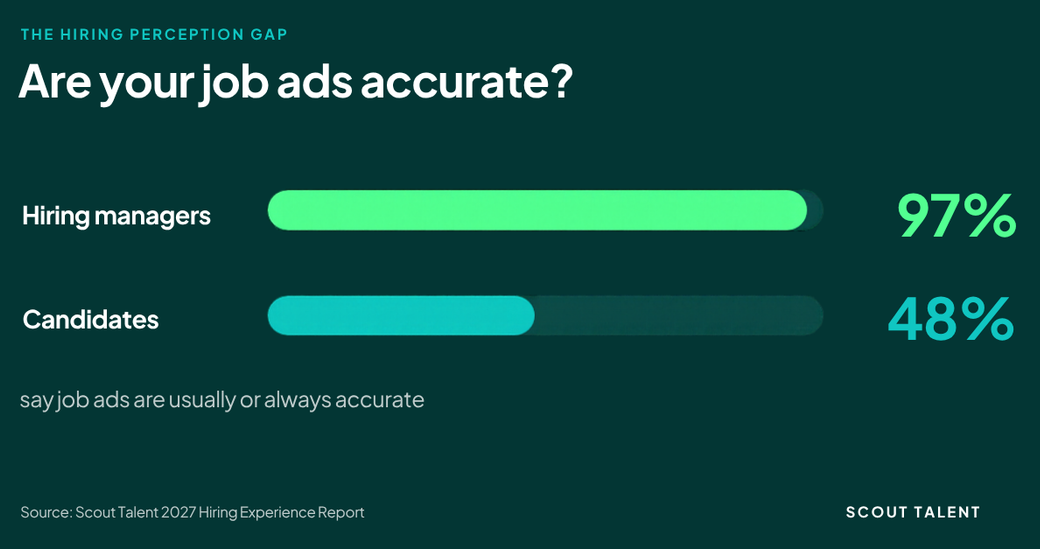
This was the finding that surprised me most. It’s not a small difference in perception: it means half the people applying start the relationship feeling misled. Most ads aren’t dishonest. They’re written from the inside, as a list of requirements and a company history, when candidates want to know what they’ll actually do every day and what success looks like.
And it’s not just job ads. The same pattern shows up right across the hiring process. When we asked hiring managers and candidates the same questions, they often described two very different experiences, from the reasons given after an interview to how candidates feel about AI screening. You’ll find every comparison in the full report.

If I had to pick one gap to close first, it would be feedback. 90% of candidates say personalized feedback matters, yet only 53% of hiring managers say they usually give it. Candidates put real time and energy into applying, and a few thoughtful lines tell them that effort was noticed. It also keeps the door open: today’s unsuccessful candidate could be the right fit for your next role, a future customer, or the person who refers someone great.
At the very least, anyone you’ve shortlisted and spoken with, even briefly on the phone, should receive a personalized note. With AI, that no longer needs to take hours. It can draft a message from your interview notes, with a person reviewing it before it goes out.
I don’t read any of this as hiring teams not trying. I read it as good intentions not reaching the candidate. It’s a blind spot, not a failure, and blind spots are fixable once you know where to look.
Check your own blind spots. Answer these three questions, then ask a recent candidate the same:
- Would a candidate say our job ad matched the real role?
- Did every shortlisted candidate receive a personalized note explaining our decision?
- Do we know how candidates feel about the AI in our process?
If you’re not sure of the answer, that’s usually where the gap is. Our 10-Minute Candidate Experience (CX) Audit is a quick way to find out.
2. Why Do Candidates Drop Out of Hiring Processes?
Poor communication is the most common reason candidates leave a hiring process. In our 2027 Hiring Experience Report, 47% have withdrawn because of it, and silence after applying is their single biggest frustration. In my experience, when a client loses a strong candidate, it’s rarely to a better offer. The candidate simply gave up because they didn’t hear back.
My advice for 2027 is simple: treat candidates like customers. Think about how hard you work to win a customer. You respond quickly, you follow up, you thank them. Now think about how most of us treat candidates. We take a week to respond, go quiet after the interview, and never close the loop.
Timing matters more than most teams realize. In our research, 41% of candidates assume they’ve missed out after one to two weeks without hearing back. My colleague Carlos Amador, our Head of Talent Acquisition, puts the fix simply:
“The simplest fix is staggered updates. Keep candidates informed at regular points in the process, even when there’s no news to share yet.”
What to do: Set three standards for every applicant: acknowledge the application quickly, tell candidates what happens next and roughly when, and close the loop with everyone, even if it’s a no. None of this costs money. It costs attention.
3. How Do Candidates Really Feel About AI in Hiring?
Surprisingly, candidates are more comfortable with AI in hiring than most employers expect. Many are happy for it to handle tasks like scheduling and screening. What they want are clear boundaries: 86% want employers to disclose when AI is used to assess them, and only 6% are comfortable with AI making the final hiring decision.
Getting this right matters more every year. AI now sits on both sides of the hiring table, and Greenhouse reports that 63% of job seekers have already faced an AI interview, with 38% walking away from a process because of one. In 2027, candidates will judge employers less on whether they use AI and more on how openly they use it.
When that openness is missing, candidates fill the gap themselves. As one put it in our survey: “It took longer to apply for the job than it did for AI to turn me down.” The full report explores how candidates feel when they believe AI has rejected them, and what would make an AI-supported process feel more human.
The way I draw the line is simple. AI can draft, summarize and suggest, but the decision always stays with a person. Used that way, it clears the admin so your team has more time to pick up the phone.
I tell clients to be specific and to say it early. Put it on the careers page and in the job posting, not buried in a privacy policy. Name the tasks AI helps with, then say plainly that a person makes every decision. Here’s wording I like:
“We use AI to help schedule interviews and organize applications. Every application is reviewed by a member of our team, and all hiring decisions are made by people.”
That one sentence answers the two things candidates care about most.
What to do: Add a short note to your careers page or job postings explaining where AI supports your process and where your team makes the decisions. For a deeper look at testing your own screening tools, read AI Hiring Compliance: Why It Matters.
4. How Is AI Changing Job Applications?
AI is making job applications more polished and more plentiful. In 2027, almost every application on your desk will have had some help from AI. Among the candidates we heard from, 63% use AI to write their resume or cover letter, and most believe that’s acceptable in at least some cases. I’d agree. Using AI to present real experience well is smart preparation.
We’re seeing it in almost every role. Cover letters and resumes are more polished and more alike, so the written application tells you much less than it used to. That changes where the real assessment happens: we now put more weight on the phone screen and the interview, where candidates talk through their own examples. And at the far end, there’s a newer risk. A client recently shared a story with us about a video interview that had gone well, until the team watched the recording back and saw the candidate’s face glitch for a split second, revealing a completely different person behind the screen. They pulled the offer before it went out.
The uncertainty cuts both ways. While hiring teams wonder whether an application reflects the real person, 66% of candidates now worry their application will be wrongly flagged as written by AI. Many told us they’d be more likely to disclose their AI use if they were simply asked. To me, that says honesty is there when the ground rules are clear.
When an organization hasn’t said where it stands on AI, candidates are left to guess, and so is the hiring team. Clear ground rules remove that guesswork on both sides. They don’t need to be complicated. A short line in your job posting or on your careers page is enough, for example:
“We welcome the use of AI to help with structure and wording. Your experience, examples and answers should be your own, and we’ll ask you to talk us through them at interview.”
That one line tells candidates what’s welcome, sets an honest standard, and gives your team something fair to assess against. It also means you can rely less on AI detection tools, which can get it wrong and penalize the very candidates being honest with you.
What to do: Write two or three sentences on how candidates can use AI in your application process, and add them to every job posting and your careers page. Then let your interviews do the rest, which is where the next trend comes in.
5. How Many Interviews Should a Hiring Process Have?
For most roles, two in-depth interviews, backed by a relevant skills assessment, are enough. That’s what 61% of candidates consider reasonable. As my colleague Helen Dwyer, General Manager, Product and Technology, puts it: “Two strong, well-structured interviews will tell you more than five.”
Two interviews are only enough if each one counts, and that starts before the first conversation. It’s surprisingly common to discover halfway through a search that two decision-makers pictured two different people. Fifteen minutes agreeing on what great looks like, before the ad goes up, gives everyone the same picture of who you’re looking for.
That picture also tells you how to use your two interviews. The first can explore experience, motivation and fit. The second can be built around a real task tied to the role. If great means solving problems under pressure, give candidates a real problem to talk through. If it means explaining complex ideas simply, ask them to walk you through a past project as if you were new to the field. When every resume sounds strong on paper, and 73% of candidates expect to prove their skills more than they did a year ago, that task will tell you more than any resume can.
In my experience, extra rounds rarely surface new information. They mostly repeat the same questions with new people while your best candidate accepts an offer somewhere else. One caveat: keep the task proportionate. It should be something a candidate can prepare in an hour or two and talk through in the interview, not a free consulting project. That respects their time and still tells you how they think.
A task is also the best way to assess AI skills. Most candidates feel positive about building them, but few are ever asked to show them. Rather than asking whether someone uses AI, ask them to walk you through how they’d use it on that task. You’ll quickly see the difference between someone who lists AI on their resume and someone who uses it well.
What to do: Before your next role goes live, agree in writing on what success looks like six months in. Then build your interviews around one real task tied to the role, and design your questions assuming candidates have prepared with AI, so you’re assessing how they think.
6. Should Job Postings Include a Salary Range?
Yes. In several Canadian provinces, including BC, Ontario and PEI, it’s already the law, and a growing number of US states have similar rules. Candidates expect it too: in our 2027 Hiring Experience Report, 92% said they’re more likely to apply when the salary range is listed.
But now that more employers post pay, including it won’t make you stand out. How you present it will. Keep the range realistic. One that spans $40,000 to $90,000 tells candidates you haven’t decided what the job is, and attracts applicants who are too junior or too senior. A tighter range brings in people at the right level.
I’ve seen the impact firsthand in British Columbia, where salary ranges have been mandatory on job postings since November 2023. Candidates have become far more decisive. Fewer apply “just to find out”, so the people who do apply are better matched to the role, and when a range is missing, candidates notice. A clear, realistic range tells them you’ve thought the role through and you’ll be upfront with them, which is exactly the kind of employer the best candidates want to work for.
Then show the whole package, from benefits to flexible hours to paid training. For some candidates, a package that suits their needs can make a slightly lower salary the more attractive offer.
The difference a clear range makes can be dramatic. One manufacturer we worked with had a posting with about 1,800 views and only 11 applicants. It had no salary, opened with the company history and listed 14 requirements. We added a range, led with the role and cut the requirements to six essentials. Within two weeks, applications and quality were both up. Same company, same job, same budget, better ad.
What to do: Put a clear, realistic salary range and the full package on every posting, and open with what the person will do and achieve. For more, read How to Get More Qualified Job Applicants.
7. How Long Should a Hiring Process Take?
A realistic hiring process takes about three to four weeks from application to offer, and six to eight weeks from posting to start date once notice periods are included. Candidates aren’t far off: 82% expect one to four weeks from application to offer. So much of the gap comes down to expectations, and telling candidates your timeline upfront closes most of it.
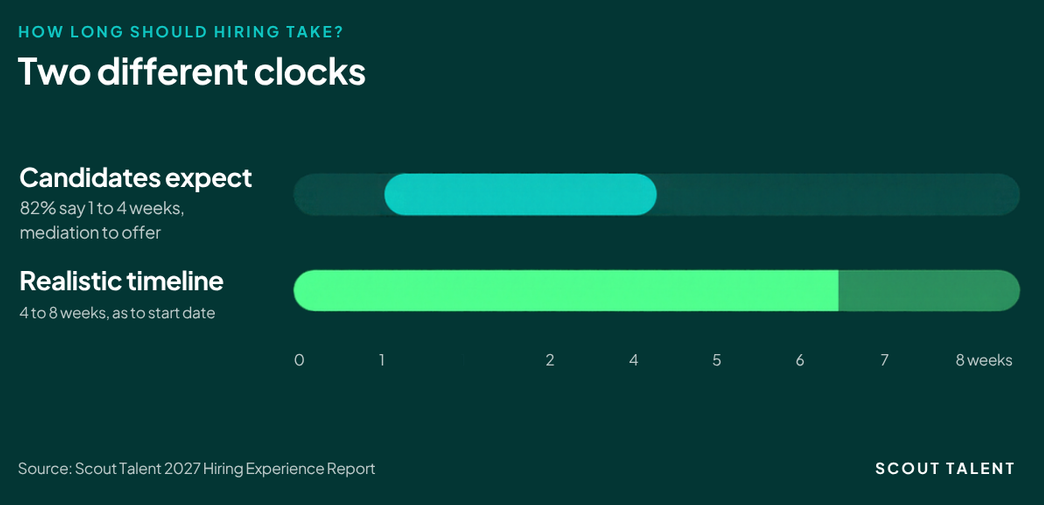
That said, every week still counts. Nearly half of candidates (45%) have walked away from a process because it took too long, and in a market where many organizations are hiring fewer people, losing your preferred candidate costs more.
Much of that time is lost between steps rather than during them: waiting on interview feedback, chasing calendars and getting approvals. Those gaps are where strong candidates slip away, but they’re also the easiest to close. When everyone involved knows their role and turnaround time before the first interview, a great candidate can move from application to offer without days lost in between.
I explain it the way I’d explain any project timeline: here are the stages, here’s roughly when each one happens, and here’s when you’ll hear from us, even if there’s no news yet. Candidates don’t mind a reasonable process. What they mind is not knowing where they stand. If we tell them it’s four weeks and then keep that promise, we earn trust that carries right through to the offer.
What to do: Publish your expected timeline and number of interview stages in every posting, agree on a turnaround time for interview feedback, and use automated scheduling to remove the back-and-forth.
How Can You Prepare for the 2027 Hiring Trends?
The best way to prepare is to focus on trust, because it’s the thread running through all seven trends. Candidates trust that your ad is honest, that a person will read their application, and that you’ll get back to them. You trust that the person you hire is the person you interviewed. Earn that trust with candidates the way you earn it with customers, and the right people will start finding you.
You don’t need a full overhaul to get there. Our report sets out six practical steps:
- Start with what’s human. Map the moments where a person must be involved (interviews, feedback and the final decision), then build your technology around them.
- Tell candidates what to expect. Publish your stages, timeline, salary range and where AI is used.
- Never leave candidates in silence. Acknowledge every application and update candidates within one to two weeks.
- Make feedback possible at scale. Use AI to draft personalized outcome messages from your notes, with a person reviewing before they’re sent.
- Let AI handle the admin. Use automation for volume, screening and scheduling, so your team has more time for conversations.
- Assess what really matters. Run fewer, better-structured interviews backed by relevant skills testing.
The full report walks through each step with examples and commentary from Scout Talent’s leaders.
If you change only one thing before January, make sure no candidate is left wondering. Set one standard: every applicant is acknowledged, every shortlisted candidate gets an update at least every week, and everyone you’ve spoken with gets a personal close-out, even if the answer is no. It costs nothing but attention, and the people you turn down this year may be the hires, customers or referrers you need next year.
Download the 2027 Hiring Experience Report to see the complete data from 500+ candidates, every hiring manager comparison, and practical frameworks to win the best talent in 2027.
Ready to make your hiring process work harder? Whether you want to improve the candidate experience, streamline your recruitment or attract the right people faster, our team can help. Talk to our team today!
Better recruitment. Stronger organizations.
About the 2027 Hiring Experience Report
The findings in this article come from Scout Talent’s 2027 Hiring Experience Report.
- Respondents: more than 500 candidates and a group of hiring managers, who answered matching questions so their views could be compared directly
- Candidate locations: Australia (48%), Canada (21%), the US (10%) and other countries (21%)
- Candidate profile: 71% were actively job seeking, and 24% were open to opportunities but not actively looking
- When: September 2026
- Method: online survey
Statistics from other sources are credited where they appear.